A lecture recording lets me return to what was said, but a folder of audio files does not organize my thinking for me. For this post, I asked AI to turn an audio memo from a lecture on using AI into a blog draft. The useful part was not simply shortening the recording. It was separating what I heard in the lecture from my own interpretation and from anything that still needed checking.
1. Start with the thread, not a list of tools
The surviving draft follows four ideas: prompts, classroom context, tool use, and revision. For a teacher, the question that ties them together is: “What would AI need to know to understand my lesson?” That is more useful than listing product names. I need to explain the learning goal, the students, the classroom conditions, and the kind of answer I want to review.
2. Keep lecture notes and invented examples apart
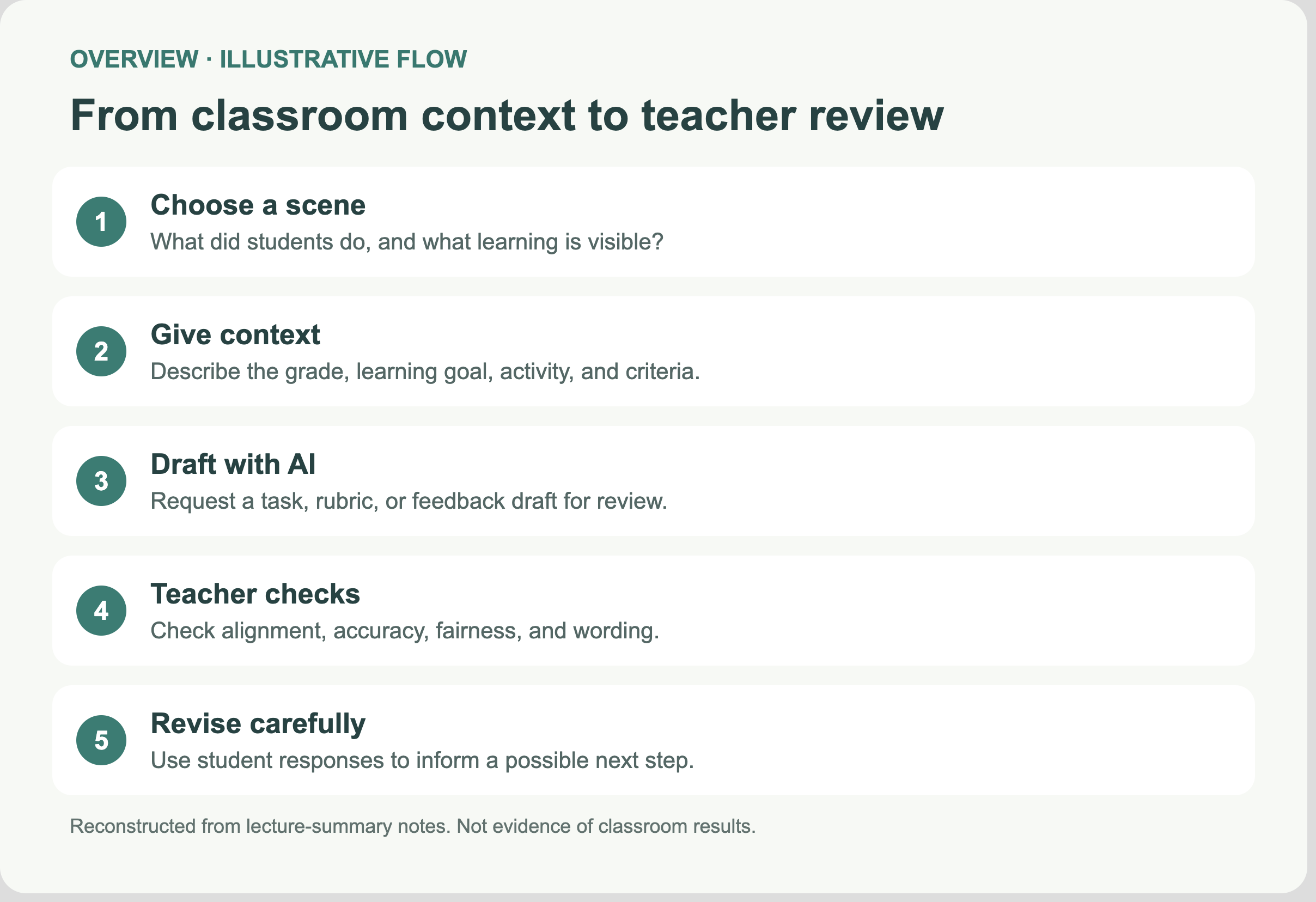
An earlier draft included an example lesson in which students investigate an environmental problem and propose solutions, along with an assessment rubric. I created that example to explain an idea. It is not a record of a lesson I taught or of outcomes I measured. Marking it clearly as an illustration helps readers distinguish the lecture material, my interpretation, and a newly constructed example.
3. Give the drafting request a fact-checking rule
Turn the transcript below into a blog draft. Separate points confirmed by the lecture, my own interpretation, and anything that needs further checking. Do not guess unclear service names. If you create an illustrative example, do not describe it as a real classroom application.
This is an example request written for this post, not a verbatim prompt I used in the past.
4. Make the final judgment in my own words
A smooth AI-written sentence is not enough. Before publishing, I check whether I agree with it, whether a lecturer’s claim has been turned into my personal experience, and whether an untried idea sounds like a completed lesson. I also check whether any example actually connects to the learning goal.
I do not want a blog post to be only a condensed recording. I want it to say what I learned, what I still need to verify, and what small step I might try in a future lesson. AI can organize the first draft; the judgment that makes it my record remains mine.
AI for teachers · Lecture notes · Audio memos · Blog writing · Lesson design
Leave a Reply