Category: K-Teacher

  • The 2027 civil-service raise is 3.9 percent. My monthly pay rises about 168,000 won

    The 2027 civil-service raise is 3.9 percent. My monthly pay rises about 168,000 won

    English

    By Jisub Seo
    14-year elementary teacher | External cooperation director, Jeonnam Teachers’ Union

    The 2027 civil-service raise is 3.9 percent, and it applies to base pay only. The January and July seniority allowance is 50 percent of that month’s base pay, and the holiday bonus is 60 percent, so those two move with the base. Flat allowances do not move. On my 10-plus-year calculation, 2027 pretax pay is about 69.3 million won. That is about 168,000 won more per month than 2026. Multiplying the whole paycheck by 3.9 percent is the wrong sum.

    The headline follows 3.0 percent in 2025 and 3.5 percent in 2026. It is the largest raise in 16 years, according to the budget report. I am past year 10 and do both department work and teaching, so I split what rises from what stays flat.

    • Base pay: plus 3.5 percent in 2026, plus 3.9 percent in 2027
    • Seniority allowance in January and July: 50 percent of that month’s base, so it rises
    • Holiday bonus at Lunar New Year and Chuseok: 60 percent of that month’s base, so it rises
    • Teaching allowance, flat meal allowance, research allowance, and the flat seniority add-on: frozen

    Starting from about 65.5 million won pretax in 2025, base about 45.7 million:

    • 2026, plus 3.5 percent: base about 47.3 million, pretax about 67.28 million, about 1.76 million more
    • 2027, plus 3.9 percent: base about 49.15 million, pretax about 69.3 million, about 2.02 million more than 2026

    That leaves out the yearly step increase. Even so, 2027 sits just under 70 million won pretax.

    Per month, 2026 is about 146,000 won above 2025. 2027 adds about 168,000 won on top of 2026. Over two years, that is about 314,000 won a month above 2025. Ordinary months (February, April, June, August, October, November) add about 130,000 to 140,000 won. January, July, and September, when base-linked allowances pay out, differ by 210,000 to 230,000 won or more.

    The March performance bonus is the variable. An S grade in 2027 would pay about 800,000 to 900,000 won more than an A grade. Pretax would be about 70.17 million won, and the monthly rise versus 2026 would be about 240,000 won.

    Crossing 70 million won does not move the tax bracket from 15 percent to 24 percent. Income tax uses taxable income, not total pay. After the earned-income deduction (about 12.8 million won), the full pension contribution deduction, health insurance, and personal deductions, taxable income stays in the low-to-mid 40 millions. The 24 percent band starts above 50 million won of taxable income.

    Counting only the allowances tied to base pay gives a smaller number than 3.9 percent of the whole check. It is closer to what actually hits the account. A step increase on top of this would add a bit more.

    Source report: 2027 budget, 3.9 percent civil-service raise

    2027 civil-service salary increase

    계산표와 보도자료 / Salary calculation & source

    네이버 원문에서 정리한 2027년 공무원 보수 3.9% 인상 내용을 사진으로 묶었습니다. 인상분은 본봉에 붙고, 정근수당과 명절휴가비는 본봉을 따라 오르며, 정액 수당은 그대로라는 계산입니다. 10여 년 차 기준 세전 약 6,930만 원, 2026년보다 월평균 약 16만 8천 원이라는 설명을 함께 확인할 수 있습니다.

    한글

    서지섭
    14년차 초등교사 | 전남교사노동조합 대외협력국장

    2027년 공무원 보수 인상은 3.9%이고, 붙는 곳은 본봉뿐입니다. 정근수당은 그달 본봉의 50%, 명절휴가비는 60%라 본봉을 따라 오릅니다. 정액 수당은 그대로입니다. 10여 년 차 기준으로 계산하면 2027년 세전 총액은 약 6,930만 원이고, 2026년보다 월평균 약 16만 8천 원 늘어납니다. 전체 급여에 3.9%를 곱하면 틀립니다.

    2025년 3.0%, 2026년 3.5% 다음이고, 보도에는 16년 만에 가장 큰 폭이라고 나옵니다. 교단에 선 지 10여 년이 넘었고 부장 업무와 수업을 같이 맡고 있어서, 오르는 항목과 그대로인 항목을 나눠 봤습니다.

    • 본봉: 2026년 +3.5%, 2027년 +3.9%
    • 정근수당(1월·7월): 그달 본봉의 50%, 본봉과 함께 오름
    • 명절휴가비(설·추석): 그달 본봉의 60%, 함께 오름
    • 교직수당, 정액급식비, 교원연구비, 정근수당가산금: 동결

    2025년 세전 총소득 약 6,550만 원, 본봉 약 4,570만 원에서 시작했습니다.

    • 2026년(+3.5%): 본봉 약 4,730만 원, 세전 약 6,728만 원, 약 +176만 원
    • 2027년(+3.9%): 본봉 약 4,915만 원, 세전 약 6,930만 원, 전년보다 약 +202만 원

    호봉 승급분은 빼었습니다. 그래도 2027년 세전은 7,000만 원 바로 아래입니다.

    월로 나누면 2026년은 2025년보다 약 14만 6천 원, 2027년은 2026년보다 약 16만 8천 원입니다. 2년 누적은 2025년 대비 월평균 약 31만 4천 원입니다. 평달(2, 4, 6, 8, 10, 11월)은 월 13만~14만 원입니다. 본봉 연동 수당이 나오는 1월, 7월, 9월은 21만~23만 원 이상 차이 납니다.

    3월 성과상여금이 변수입니다. 2027년 S등급이면 A등급보다 약 80만~90만 원이 더 나오고, 세전은 약 7,017만 원입니다. 그때 월평균 상승은 올해 대비 약 24만 원입니다.

    7,000만 원대가 된다고 세율이 15%에서 24%로 바뀌지는 않습니다. 소득세는 총급여가 아니라 과세표준에 매깁니다. 근로소득공제 약 1,280만 원, 공무원연금 기여금, 건강보험료, 인적공제를 빼면 과세표준은 4,000만 원대 초중반입니다. 24%는 과세표준 5,000만 원 초과부터입니다.

    본봉에 묶인 수당만 계산하니, 3.9%를 통째로 곱한 값보다 작습니다. 통장에는 이쪽이 더 가깝습니다. 해마다 오르는 1호봉까지 더하면 체감은 조금 더 나아집니다.
    보도: 2027 예산, 공무원 보수 3.9% 인상

    원문: https://blog.naver.com/seojisub/224397334412

  • Beyond the Screen: A Critical Look at Korea’s AI Digital Textbooks


    [EN] Hi everyone, it’s Jisub. Today, I want to share a column I recently wrote for a Korean news outlet. It’s about the “AI Digital Textbooks (AIDT)”—the hottest and most controversial topic in Korean education right now. While the technology is flashy, I wanted to question where the underlying educational philosophy truly lies.


    English Version: Digital Platform Government and AI Textbooks

    By Jisub Seo, Policy Director of Jeonnam Teachers’ Union

    (Originally published on April 21, 2025)

    The debate over AI Digital Textbooks is not just about adopting new technology. It is a fundamental question about our educational philosophy and how we prepare the next generation.

    1. A Rushed Innovation?

    On January 17, 2025, the National Assembly held a hearing to discuss the rapid implementation of AI Digital Textbooks. The government aims for a full-scale rollout by 2025. However, the process has felt more like a political sprint than a pedagogical evolution. The initial planning was led by technology experts, with a noticeable absence of classroom teachers and educational specialists.

    2. Market Logic vs. Educational Integrity

    Since the current administration took office, education policy has leaned heavily toward market-driven models. We are seeing structures where private companies can profit through public education under the guise of “digital transformation.” This raises serious concerns about the commercialization of our classrooms.

    3. The Harsh Reality of the Classroom

    In the field, we are facing practical nightmares:

    • Server Failures: Constant overloads preventing students and teachers from accessing materials.
    • Administrative Burden: Complex login processes (Digital One-pass) that force teachers to spend more time on tech support than teaching.
    • Content Errors: Technical bugs where answers are marked incorrectly, hindering the quality of learning.
    • Lack of Collaboration Support: The system fails to accommodate co-teaching scenarios, such as those with Native English Teachers.

    4. The Fundamental Question: Why?

    We must ask: Why are we doing this? If the goal is digital literacy, we must address parental concerns about screen time. If it’s for learning efficiency, we must listen to pedagogical experts. If it’s to support teachers, then the voices of those in the classroom must be at the center of the policy—not marginalized.

    Conclusion: People Over Technology

    Education should be a public promise, not a political slogan. For AI textbooks to be a true innovation, we must clarify their purpose and establish a democratic process involving students, parents, and teachers. Technology is just a tool; the soul of education is, and always will be, the people.


    🇰🇷 국문 버전: 디지털플랫폼 정부와 디지털교과서

    [세 번째 이야기] 화면 너머의 본질: AI 디지털교과서를 향한 뼈아픈 질문

    [KR] 안녕하세요, 지섭입니다. 오늘은 제가 작년 언론사에 기고했던 칼럼을 공유해 보려 합니다. 현재 한국 교육계의 가장 뜨거운 감자인 ‘AI 디지털교과서(AIDT)’에 대한 이야기인데요. 기술은 화려하지만, 그 안에 담긴 교육 철학은 어디에 있는지에 대한 저의 고민을 담았습니다.

    (전남교사노조 정책실장 서지섭 칼럼 / 2025.04.21 기고)

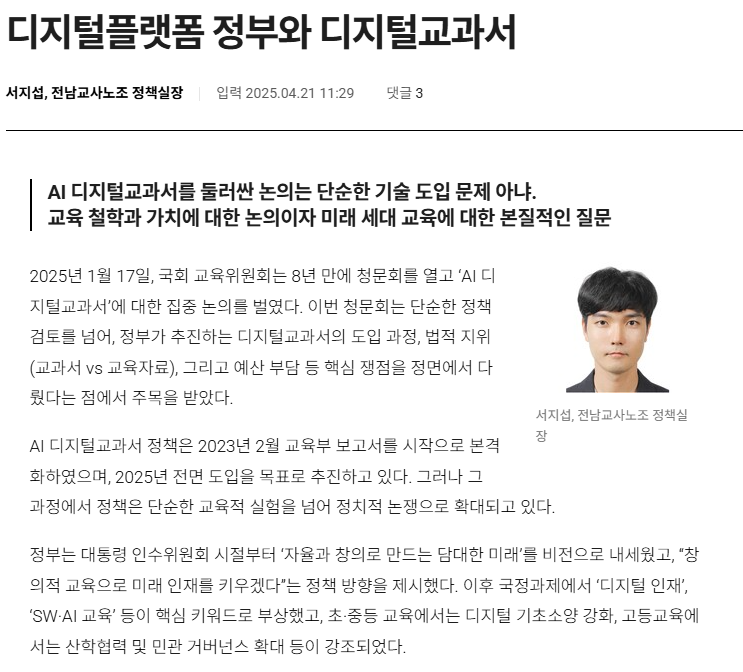
    AI 디지털교과서를 둘러싼 논의는 단순한 기술 도입의 문제가 아닙니다. 이것은 우리가 어떤 교육 철학을 지향하며, 미래 세대를 어떻게 책임 있게 교육할 것인지에 대한 본질적인 질문입니다.

    (주요 요약)

    1. 준비 없는 속도전: 2025년 전면 도입을 목표로 달려왔지만, 초기 정책 수립 과정에서 교육 전문가와 현장의 목소리는 배제되었습니다.
    2. 시장의 논리: 사립학교와 민간기업이 교육을 매개로 이윤을 추구할 수 있는 구조가 마련되며 교육의 공공성이 위협받고 있습니다.
    3. 현장의 비명: 접속 장애, 번거로운 가입 절차, 콘텐츠 오류, 그리고 원어민 협력 수업의 미반영 등 현장에서는 실질적인 장애 요인들이 쏟아지고 있습니다.
    4. 본질로의 회귀: 교육부 장관의 의지인지, 대통령의 공약인지도 불분명한 이 정책의 중심에 정작 교육의 주체인 학생과 교사는 없습니다.

    결론적으로, 기술보다 중요한 것은 사람입니다. 진정한 혁신은 전문성과 민주성을 바탕으로 한 숙의의 과정에서 시작되어야 합니다.


    #AIDT #AI_Digital_Textbook #Education_Policy #K_Education #EdTech, #Teacher_Voice, #Pedagogy